If you run a business registered in Singapore and need to deal with overseas banks, investors, regulators, or business partners, chances are you will be asked for your ACRA Business Profile in a language other than English, or you will need to submit a translated version of it for use in another country. This document, often shortened to “Biz Profile,” is one of the most commonly requested corporate records for foreign companies expanding internationally, applying for overseas licences, or entering into cross border transactions.
This guide explains what an ACRA Biz Profile is, why foreign companies often need it translated, and what to expect from the certified translation process in Singapore.
What Is an ACRA Biz Profile
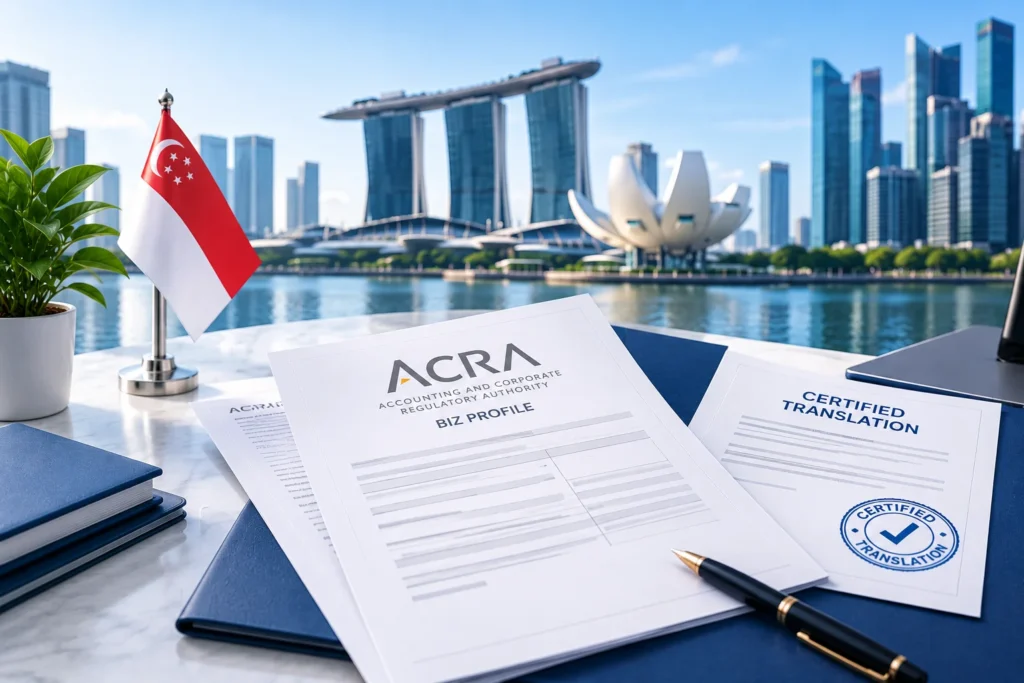
An ACRA Biz Profile is an official business information report issued by the Accounting and Corporate Regulatory Authority of Singapore. It contains key details about a registered company, including its registration number, incorporation date, registered address, principal business activities, shareholders, directors, and paid up capital.
Because it is issued directly by a Singapore government agency, the Biz Profile is widely accepted as proof of a company’s legal existence and standing. It is commonly required for:
- Opening corporate bank accounts overseas
- Applying for business licences or permits in another country
- Entering joint ventures or partnership agreements abroad
- Due diligence checks during mergers, acquisitions, or investment rounds
- Visa or work pass applications tied to business ownership
- Tender submissions for overseas government or private contracts
Why Foreign Companies Need the Biz Profile Translated
The ACRA Biz Profile is issued in English. For companies operating in Singapore, this is usually sufficient. However, problems arise when the document needs to be submitted to an authority, bank, or business partner in a country where English is not an official or accepted language.
For example, a Singapore registered company expanding into China, Vietnam, Japan, or parts of the Middle East may be asked to provide a certified Chinese, Vietnamese, Japanese, or Arabic translation of their Biz Profile before local authorities will process an application. Similarly, foreign investors or regulators reviewing a Singapore company’s structure may require the document translated into their native language to complete due diligence properly.
In these cases, a plain or informal translation is rarely enough. Most government bodies and financial institutions require a certified translation, one that is accompanied by a signed statement confirming the translation is accurate and complete, along with the translator’s credentials.
What Makes a Translation “Certified” for Business Use
A certified translation is different from a standard translation in a few important ways. It typically includes:
- A faithful, word for word rendering of the original document’s content
- A signed certification statement from the translator or translation agency
- The translator’s name, qualifications, and contact information
- In some cases, a company stamp or seal confirming the translation’s authenticity
This level of formality is what allows overseas banks, regulators, and government departments to trust that the translated Biz Profile accurately reflects the original ACRA record. If you are unfamiliar with how certification works more broadly, our article on certified and professional translation services in Singapore breaks down the process in detail.
Common Challenges Foreign Companies Face
Formatting and Legal Terminology
The ACRA Biz Profile contains specific legal and corporate terminology, such as “paid up capital,” “registered office,” and “principal activities” classifications under the Singapore Standard Industrial Classification (SSIC) codes. These terms need to be translated accurately and consistently, since a mistranslation could misrepresent a company’s structure or activities to a foreign authority.
Recognition by Local Authorities
Different countries have different standards for what counts as an acceptable certified translation. Some jurisdictions may also require the translation to be further authenticated or notarised before it is accepted locally. It is worth checking the specific requirements of the receiving country or institution before submitting your documents, since this can affect both the translation process and the timeline.
Confidentiality Concerns
Business profiles often contain sensitive details about shareholders, directors, and company structure. Companies should work with a translation provider that follows strict confidentiality protocols, including non disclosure agreements and secure file handling, particularly when the document is being used for investment, acquisition, or regulatory purposes.
Do You Need Notarization or Authentication Too
In many cases, a certified translation alone is sufficient. However, some overseas authorities, particularly those involved in formal legal proceedings, large scale investment, or government licensing, may also require the translated document to be notarised or authenticated before it is accepted.
Notarization confirms that the translation was properly executed, while authentication (sometimes done through the Singapore Academy of Law) adds a further layer of verification recognised internationally. If your business dealings involve a country with stricter document requirements, it is worth confirming upfront whether notarization or authentication will be needed alongside the translation, so the entire process can be completed in one go rather than in separate steps.
How the Translation Process Typically Works
Step 1: Obtain your Biz Profile
You can request an up to date ACRA Business Profile through BizFile+, ACRA’s online portal, usually within minutes.
Step 2: Submit the document for translation
Share a clear copy of the Biz Profile with a certified translation provider, along with the target language and intended use (such as bank submission, licensing, or investment due diligence).
Step 3: Translation and quality review
A qualified translator, often one with experience in corporate or legal translation, completes the translation. A second reviewer typically checks the document for accuracy before it is finalised.
Step 4: Certification
The completed translation is certified with a signed statement and, if needed, a company stamp confirming its accuracy.
Step 5: Notarization or authentication (if required)
If the receiving country requires further verification, the certified translation can be notarised or authenticated as an additional step.
Most certified business document translations in Singapore can be completed within one to three working days, though this can vary depending on document length, language pair, and whether additional verification steps are needed. If you are working against a tight deadline for an overseas submission, it is worth flagging this early so the turnaround can be adjusted accordingly.
Other Business Documents That Often Need Translation
An ACRA Biz Profile is rarely the only corporate document foreign companies need translated. Depending on the nature of your overseas dealings, you may also need certified translations for:
- Corporate constitutions and shareholder agreements
- Investment prospectuses and proposals
- Mergers and acquisitions documentation
- Annual reports and financial statements
- Board resolutions and meeting minutes
If your business regularly deals with cross border transactions, it is worth establishing a relationship with a translation provider that understands corporate and financial terminology, rather than sourcing translations on an ad hoc basis each time.
Frequently Asked Questions
How long is an ACRA Biz Profile valid for translation purposes?
There is no fixed expiry, but many overseas institutions prefer a Biz Profile that was issued within the last one to three months to ensure the information is current.
Can the translation be done into more than one language at a time?
Yes. If your business is dealing with multiple countries or partners, you can request translations into several languages from the same source document.
Will a machine translated version be accepted?
Generally, no. Most banks, regulators, and government bodies require translations completed by a qualified human translator, with proper certification, rather than machine generated output.
Do I need to provide the original Biz Profile, or is a digital copy enough?
A clear digital copy, such as a PDF downloaded from BizFile+, is usually sufficient for translation purposes.
Get Your Business Documents Translated With Confidence
Expanding across borders already involves enough moving parts without worrying whether your corporate documents will be accepted overseas. If you need your ACRA Biz Profile or other business documents translated and certified for international use, our team can guide you through exactly what is required for your target country.
Visit our business translation services page to learn more, or reach out for a free quote and we will help you get your documents ready for submission without delays.