Singapore’s role as a manufacturing, engineering, and trade hub means technical documentation regularly moves across borders and languages. A user manual written in German, a set of engineering specifications from Japan, or a safety report from China often needs to be translated accurately before it can be used, approved, or distributed locally. Unlike general translation, technical translation carries a unique challenge: the content is dense, precise, and often tied directly to safety, compliance, or product performance.
Getting it wrong isn’t just inconvenient. A mistranslated specification can lead to equipment failure, safety incidents, regulatory rejection, or costly rework. Here’s what businesses in Singapore need to know about technical document translation and how to choose a provider who can actually handle it.
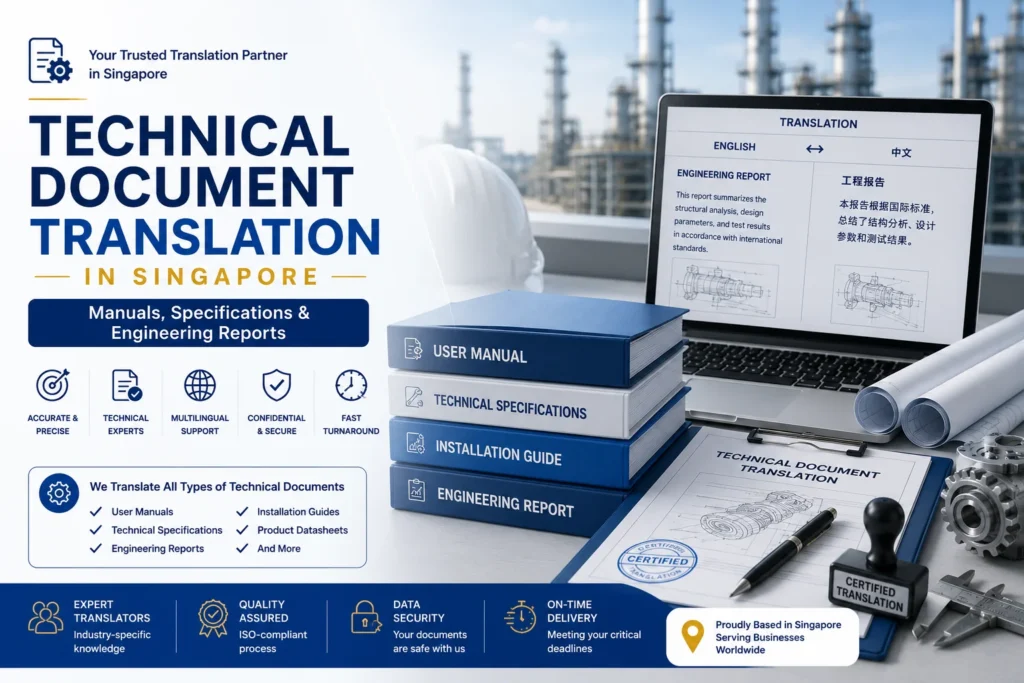
What Counts as a Technical Document?
Technical translation covers a broad range of content, including:
- User manuals and product guides
- Engineering drawings and specifications
- Safety data sheets (SDS) and compliance documents
- Standard operating procedures (SOPs)
- Installation and maintenance guides
- Quality assurance and inspection reports
- Patent applications and technical filings
- IT and software documentation
If a document is meant to instruct, specify, or certify how something works, it likely falls into this category, and it needs a translator who understands the subject matter, not just the language.
Why Technical Translation Requires Subject Matter Expertise
General translators, even highly skilled ones, often lack the domain knowledge to translate technical content accurately. Technical documents use specialized vocabulary, industry standard terminology, and precise measurements that must carry the exact same meaning in the target language. A translator without engineering, manufacturing, or scientific background can easily:
- Mistranslate industry specific terms that have no direct equivalent
- Misinterpret units, tolerances, or technical specifications
- Miss context that changes the meaning of an instruction
- Produce a document that reads correctly but is functionally wrong
This is why technical translation is typically handled by translators with relevant industry experience, supported by a second reviewer who checks for both linguistic and technical accuracy.
Common Industries That Need Technical Translation in Singapore
- Manufacturing and industrial equipment, for machinery manuals and maintenance guides
- Construction and engineering, for project specifications and safety documentation
- Electronics and IT, for product documentation and software localization
- Oil, gas, and marine, for compliance and operational reports
- Pharmaceuticals and medical devices, for regulatory and technical filings
- Logistics and shipping, for customs and operational documentation
Key Considerations Before You Translate
1. Consistency matters as much as accuracy. Technical documents often use the same terms repeatedly across manuals, reports, and specifications. A reliable provider will use terminology management tools such as glossaries and translation memory to keep terms consistent throughout a document, and across future updates.
2. Formatting needs to be preserved. Technical documents often include diagrams, tables, charts, and numbered steps. A good translation service will maintain the original layout so the translated version is just as usable as the source.
3. Confidentiality is critical. Engineering specifications, product designs, and technical reports often contain sensitive intellectual property. Make sure your provider signs a non disclosure agreement and follows secure file handling practices.
4. Certification may be required. If the document will be submitted to a regulator, government body, or used in a legal or compliance context, you may need a certified translation rather than a standard one. Check requirements before submission to avoid delays.
What to Look for in a Technical Translation Provider
- Native language translators with relevant technical or engineering background
- Experience translating documents in your specific industry
- A structured quality assurance process, including proofreading and technical review
- Ability to handle complex formatting, diagrams, and multi language documents
- Confidentiality safeguards for sensitive technical content
Common Mistakes to Avoid
- Relying on machine translation for technical content. Automated tools cannot reliably interpret technical context, units, or industry terminology, and errors can be difficult to catch without expert review.
- Using a general translator for specialized content. Language fluency alone isn’t enough for documents where precision has real world consequences.
- Ignoring formatting requirements. A translated manual that loses its diagrams or numbered steps becomes far less useful.
- Leaving translation until the last minute. Technical documents often require careful review, so rushing increases the risk of errors slipping through.
Final Thoughts
Technical document translation is about more than converting words from one language to another. It requires subject matter knowledge, consistency, and a process built for precision. For businesses in Singapore working across manufacturing, engineering, construction, or IT, choosing a translation partner who understands both the language and the technical content can prevent costly errors and keep projects moving smoothly.
Frequently Asked Questions
What types of documents count as technical translation?
User manuals, engineering specifications, safety data sheets, SOPs, maintenance guides, and technical reports all fall under technical translation.
Do technical translations need to be certified?
Not always. Certification is typically required when a document will be submitted to a regulator, government body, or used in a compliance or legal context. Internal use documents usually don’t require certification.
Can machine translation handle technical documents?
It’s not recommended for anything involving safety, compliance, or precise specifications. Machine translation often misinterprets technical terminology and context, which can lead to costly errors.
How long does technical document translation take?
Turnaround depends on document length, complexity, and formatting requirements. Straightforward documents can often be completed within a few working days, while longer or highly technical reports may take longer.
Need accurate technical document translation in Singapore? Contact Stanza Translations for a free quote from translators with real industry experience.