Introduction
Birth certificates are among the most important personal documents used throughout a person’s life. They serve as official proof of identity, age, parentage, nationality, and place of birth. Whether applying for immigration, educational admissions, employment opportunities, government services, family sponsorships, or legal procedures, birth certificates are often required as supporting documentation.
In today’s globalized world, individuals frequently relocate to different countries for work, education, business, or family reasons. When a birth certificate is issued in a language that differs from the language accepted by the receiving institution or authority, a translated version becomes necessary.
Certified Translation Services Singapore help individuals prepare translated birth certificates for official purposes while ensuring clarity, consistency, and professional presentation.
This comprehensive guide explains birth certificate translation, its importance, common applications, translation processes, benefits, challenges, frequently asked questions, and best practices for document preparation in Singapore.
What Is a Birth Certificate?
A birth certificate is an official civil document issued by a government authority that records an individual’s birth.
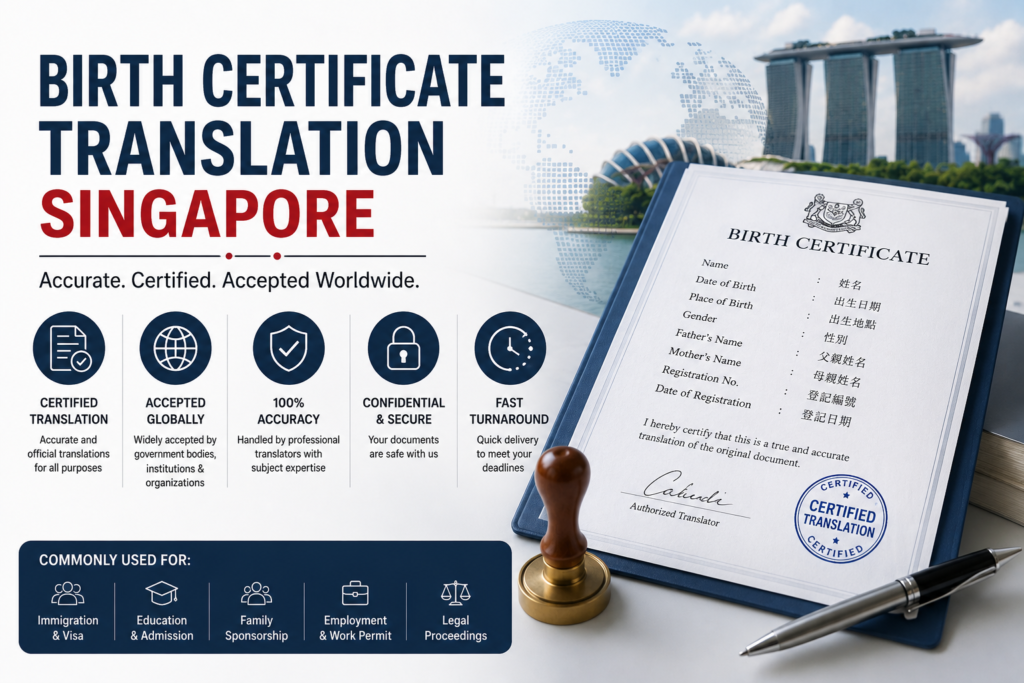
Typically, a birth certificate contains:
- Full name
- Date of birth
- Place of birth
- Gender
- Parent information
- Registration details
- Certificate number
- Issuing authority information
Because it serves as a foundational identity document, it is frequently requested for various administrative and legal procedures.
What Is Birth Certificate Translation?
Birth certificate translation refers to the process of converting the information contained in a birth certificate from one language into another while maintaining accuracy and consistency.
The purpose of translation is to ensure that the receiving authority can clearly understand the information contained in the original document.
A professionally translated birth certificate preserves:
- Names
- Dates
- Locations
- Official references
- Administrative terminology
- Document structure
Why Birth Certificate Translation Is Important
Birth certificates are often used as primary identity documents.
Accurate translation helps:
Support Official Verification
Authorities need to verify personal information accurately.
Improve Administrative Efficiency
Clear documentation reduces confusion during reviews.
Facilitate International Applications
Translation enables institutions to understand foreign-language documents.
Maintain Consistency
Personal information remains aligned across different records.
Reduce Processing Delays
Properly translated documents help avoid requests for clarification.
Common Situations Requiring Birth Certificate Translation
Many personal and professional situations require translated birth certificates.
Immigration Applications
Birth certificates are frequently required for immigration-related procedures.
Examples include:
- Residency applications
- Family sponsorship applications
- Citizenship procedures
- Long-term stay applications
Translation helps authorities review identity and family information accurately
Educational Admissions
Educational institutions sometimes request birth certificates as supporting documentation.
Examples include:
- School admissions
- University applications
- Scholarship programs
- Student visa procedures
Employment Processes
Certain employers may request birth certificates as part of verification procedures.
Examples include:
- International employment
- Government positions
- Professional licensing
Family Sponsorship Applications
Family-related applications often require proof of relationships.
Examples include:
- Parent sponsorship
- Child sponsorship
- Dependent applications
Legal Proceedings
Birth certificates may support:
- Family law cases
- Name change procedures
- Inheritance matters
- Court documentation
Government Services
Various government procedures may require birth certificate verification.
Examples include:
- Identification applications
- Administrative registrations
- Public service access
Information Typically Found on Birth Certificates
Understanding the contents of a birth certificate helps explain why accuracy is important.
Personal Information
Includes:
- Full legal name
- Gender
- Birth date
- Place of birth
Parent Information
Includes:
- Father’s name
- Mother’s name
- Parent details
Registration Details
Includes:
- Registration number
- Record number
- Filing date
Issuing Authority Information
Includes:
- Government office name
- Registration department
- Official references
The Birth Certificate Translation Process
Professional translation follows a structured process.
Step 1: Document Review
The birth certificate is assessed to determine:
- Language pair
- Formatting requirements
- Document condition
- Administrative terminology
Step 2: Terminology Verification
Official terminology is reviewed carefully.
Examples include:
- Registration offices
- Civil authorities
- Administrative references
Step 3: Translation
The document is translated while preserving:
- Names
- Dates
- Locations
- Official terminology
Step 4: Quality Review
The translated version is reviewed for:
- Accuracy
- Completeness
- Consistency
- Formatting
Step 5: Final Preparation
The completed translation is prepared for official use.
Common Languages Used in Birth Certificate Translation
Singapore’s multicultural environment creates demand for many language combinations.
Frequently requested languages include:
- English
- Chinese
- Malay
- Tamil
- Arabic
- Japanese
- Korean
- Indonesian
- Thai
- Vietnamese
- French
- German
- Spanish
These language combinations support international mobility and administrative procedures.
Challenges in Birth Certificate Translation
Although birth certificates may appear simple, several challenges can arise.
Name Transliteration
Names may have different spellings in different languages.
Maintaining consistency is essential.
Date Formats
Countries use different date formats.
Examples:
- DD/MM/YYYY
- MM/DD/YYYY
- YYYY/MM/DD
Careful conversion helps prevent confusion.
Administrative Terminology
Government departments often use country-specific terms.
Proper interpretation ensures accuracy.
Administrative Terminology
Government departments often use country-specific terms.
Proper interpretation ensures accuracy.
Handwritten Records
Older certificates may contain handwritten entries.
These require careful review.
Historical Documents
Older records may use outdated language or administrative structures.
Translation requires contextual understanding.
Importance of Consistency Across Documents
Birth certificates are often submitted alongside other records.
Examples include:
- Passports
- Marriage certificates
- Educational certificates
- Identity cards
Information should remain consistent across all documents.
Important elements include:
Names
Names should match official records.
Dates
Birth dates must remain identical.
Locations
Place names should be translated consistently.
Parent Information
Parent names should align with supporting documents.
Industries That Frequently Use Birth Certificate Translation
Immigration Sector
Birth certificates are among the most commonly translated immigration documents.
Education Sector
Schools and universities frequently review birth records.
Legal Sector
Law firms often require translated birth certificates for family-related matters.
Government Sector
Government agencies regularly process identity-related documentation.
Corporate Sector
International employers sometimes request translated personal records.
Benefits of Professional Birth Certificate Translation
Accuracy
Professional review minimizes errors.
Consistency
Personal information remains aligned across records.
Improved Readability
Authorities can review information efficiently.
International Acceptance
Translated documents support cross-border applications.
Administrative Efficiency
Well-prepared documents reduce delays.
Best Practices for Birth Certificate Translation
Submit Clear Copies
High-quality scans improve accuracy.
Verify Personal Information
Check:
- Names
- Dates
- Registration numbers
Keep Original Documents Safe
Original records remain important for verification.
Prepare Documents Early
Avoid last-minute requests.
Maintain Consistency
Ensure information matches supporting records.
Conclusion
Birth certificates are among the most important personal documents used for identity verification, family relationships, immigration procedures, educational admissions, legal matters, and government services.
Accurate translation ensures that names, dates, locations, parent information, and official references remain clear and consistent across languages. Proper document preparation supports smoother administrative reviews and reduces the likelihood of delays or misunderstandings.
As international mobility continues to increase, birth certificate translation remains an essential service for individuals, families, students, professionals, and organizations navigating multilingual environments and global opportunities.
Frequently Asked Questions
Birth certificate translation helps authorities understand identity and family information contained in foreign-language documents.
Translated birth certificates are commonly required for immigration, education, legal matters, government procedures, and family sponsorship applications.
Typical information includes the individual’s name, birth date, place of birth, parent information, and registration details.
Consistency helps prevent discrepancies between birth certificates and other supporting documents.
Immigration authorities, educational institutions, law firms, government agencies, and employers frequently require translated birth certificates.
English, Chinese, Malay, Tamil, Arabic, Japanese, Korean, Indonesian, Thai, Vietnamese, French, and German are frequently requested.