
Introduction
When preparing documents for immigration, education, employment, legal proceedings, business transactions, or international applications, individuals often encounter two commonly used terms: certified translation and notarized translation. While these terms are sometimes used interchangeably, they represent different processes and serve different purposes.
Understanding the distinction between certified and notarized translations is important because submitting the wrong type of document can lead to delays, rejections, or additional administrative requirements. Whether you are applying for a visa, enrolling in a university, registering a business, handling a court matter, or submitting documents to government authorities, knowing which translation type is appropriate can save both time and effort.
Translation Services Singapore support individuals and organizations by providing professional language solutions that help documents meet various administrative and legal requirements.
This comprehensive guide explains the differences between certified and notarized translations, their purposes, benefits, common use cases, industries that require them, and how to determine which option is suitable for your specific situation.
Understanding Translation for Official Documents
Official documents often need to be presented in a language accepted by the receiving authority. When a document is issued in a foreign language, translation becomes necessary to ensure that reviewers can accurately understand its contents.
Examples of official documents include:
- Birth certificates
- Marriage certificates
- Academic transcripts
- Degree certificates
- Employment records
- Medical reports
- Court documents
- Business contracts
- Government certificates
- Immigration paperwork
The level of verification required often determines whether a certified translation or a notarized translation is needed.
What Is a Certified Translation?
A certified translation is a translated document accompanied by a declaration confirming that the translation accurately reflects the original document.
The certification statement typically indicates that:
- The translation is complete.
- The translation is accurate.
- The content matches the original document.
- The translator or translation provider confirms its correctness.
The purpose of certification is to provide confidence in the quality and accuracy of the translated document.
Key Characteristics of Certified Translation
Accuracy Verification
The translator confirms that the translated content accurately represents the source document.
Professional Review
Documents often undergo quality checks before certification.
Suitable for Official Use
Certified translations are commonly accepted for administrative and institutional purposes.
Language Integrity
The meaning, terminology, and formatting of the original document are preserved.
Common Documents Requiring Certified Translation
Many official records commonly require certification.
Examples include:
Personal Documents
- Birth certificates
- Marriage certificates
- Divorce certificates
- Family records
Educational Documents
- Degree certificates
- Diplomas
- Academic transcripts
- School records
Employment Documents
- Experience certificates
- Employment letters
- Professional qualifications
Medical Documents
- Medical reports
- Treatment records
- Vaccination certificates
Immigration Documents
- Identity papers
- Family certificates
- Administrative records
What Is a Notarized Translation?
A notarized translation involves an additional step beyond translation and certification.
In a notarized translation process, a notary public verifies the identity of the person signing the declaration or certification associated with the translated document.
The notary does not evaluate the accuracy of the translation itself.
Instead, the notary confirms:
- The identity of the signer.
- The authenticity of the signature.
- That the declaration was signed properly.
This additional verification can be required in certain legal, governmental, or international situations.
Key Characteristics of Notarized Translation
Additional Authentication
The translation receives an extra layer of verification.
Signature Verification
A notary public confirms the authenticity of signatures.
Legal Recognition
Some institutions specifically request notarized documentation.
Formal Administrative Support
Notarization can help support official submissions requiring additional validation.
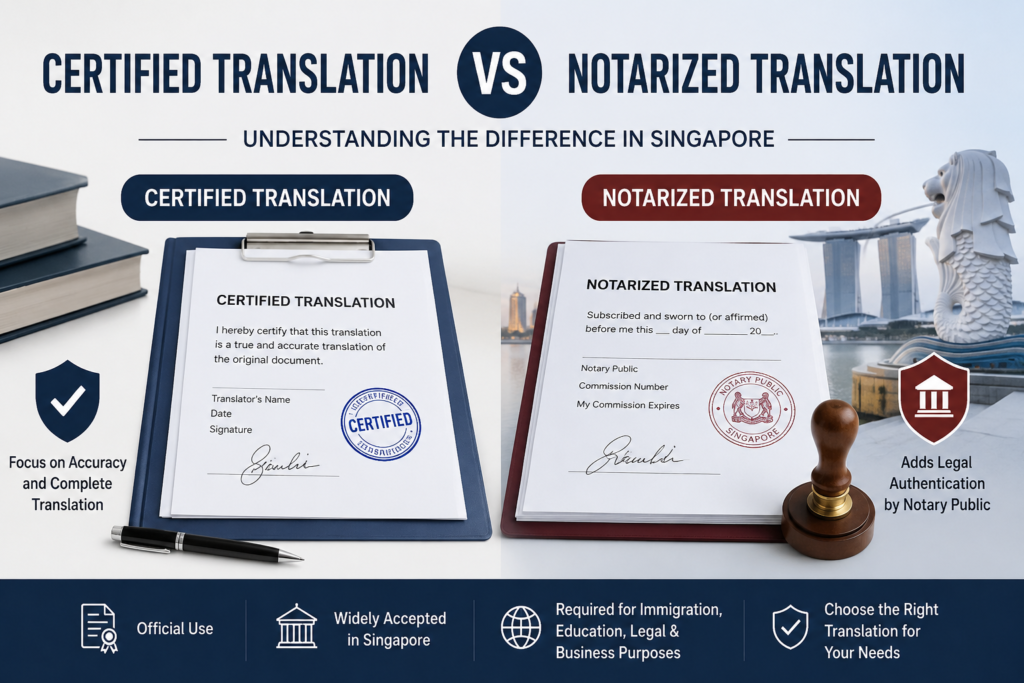
Main Differences Between Certified and Notarized Translation
Although they may appear similar, certified and notarized translations serve different functions.
Purpose
Certified Translation
Focuses on translation accuracy.
Notarized Translation
Focuses on verifying signatures and declarations.
Verification Process
Certified Translation
The translator or translation provider confirms accuracy.
Notarized Translation
A notary verifies the signature attached to the translation declaration.
Administrative Requirements
Certified Translation
Often sufficient for educational, employment, and administrative procedures.
Notarized Translation
May be required for legal, governmental, or international processes requiring extra authentication.
Level of Formality
Certified Translation
Provides professional verification.
Notarized Translation
Provides additional formal validation.
When Is Certified Translation Usually Required?
Certified translations are frequently used for:
Academic Admissions
Educational institutions often request translated academic records.
Examples include:
- Degrees
- Diplomas
- Transcripts
Employment Applications
Organizations may require translated qualifications and employment records.
Examples:
- Experience certificates
- Educational credentials
Immigration Procedures
Applicants often submit:
- Birth certificates
- Marriage records
- Family documents
Healthcare Documentation
Examples:
- Medical reports
- Treatment histories
- Diagnostic records
Administrative Applications
Government agencies often require translated records for review.
When Is Notarized Translation Usually Required?
Notarized translations are commonly associated with situations requiring additional authentication.
Examples include:
Court Proceedings
Legal matters may involve notarized documentation.
International Legal Transactions
Cross-border legal matters often require additional verification.
Corporate Transactions
Some business agreements require notarized supporting documents.
Foreign Government Submissions
Certain authorities may request notarized translations for administrative procedures.
International Property Matters
Property-related transactions may involve notarized documents.
Industries That Frequently Use Certified Translation
Education Sector
Students often require certified translations for admissions and evaluations.
Immigration Sector
Immigration procedures frequently involve translated personal documents.
Healthcare Sector
Medical institutions often require translated records.
Corporate Sector
Businesses use certified translations for:
- HR documentation
- Employment verification
- Internal communication
Government Sector
Administrative reviews often require certified records.
Industries That Frequently Use Notarized Translation
Legal Industry
Law firms frequently handle notarized documentation.
Financial Services
Banks and financial institutions sometimes require notarized records.
Real Estate Sector
Property transactions may involve notarized supporting documents.
International Business
Global transactions sometimes require additional document authentication.
Benefits of Certified Translation
Faster Processing
Certified translations are generally straightforward and efficient.
High Accuracy
Professional review helps ensure quality.
Suitable for Many Applications
Certified translations satisfy a wide range of requirements.
Cost-Effective
Certification usually involves fewer administrative steps.
Benefits of Notarized Translation
Additional Verification
Provides another layer of authentication.
Greater Administrative Acceptance
Some authorities specifically require notarized documents.
Stronger Documentation Support
Can support complex legal and international matters.
Enhanced Credibility
Additional authentication increases confidence in documentation.
Common Misconceptions
Misconception 1: Notarized Means More Accurate
A notary does not verify translation quality.
Accuracy remains the responsibility of the translator.
Misconception 2: Every Translation Needs Notarization
Many institutions accept certified translations without requiring notarization.
Misconception 3: Certified and Notarized Are the Same
They serve different purposes and involve different procedures.
Misconception 4: Notarization Replaces Translation
Notarization does not translate content.
A translation must exist before notarization can occur.
How to Determine Which Option You Need
Before preparing documents, consider:
Purpose of Submission
Educational, legal, business, or immigration applications may have different requirements.
Receiving Authority
Always review the instructions provided by the institution.
Type of Document
Legal documents may require different treatment than educational records.
International Requirements
Cross-border procedures sometimes require additional authentication.
Best Practices for Official Document Translation
Start Early
Avoid last-minute requests.
Verify Requirements
Check whether certification or notarization is required.
Submit Clear Documents
Readable source documents improve translation quality.
Maintain Consistency
Names, dates, and identification numbers should match across records.
Keep Original Documents Safe
Original records remain important for verification purposes.
Conclusion
Certified and notarized translations play important roles in official documentation, but they serve different purposes. Certified translations focus on accuracy and completeness, while notarized translations add an extra layer of authentication through signature verification.
Understanding the distinction helps individuals, businesses, students, and professionals choose the correct option for their specific requirements. Whether preparing educational records, immigration paperwork, legal documents, medical reports, or business agreements, selecting the appropriate translation process can help avoid delays and ensure smoother administrative procedures.
As international mobility, global business operations, and cross-border legal matters continue to increase, both certified and notarized translations remain valuable tools for supporting accurate communication and document acceptance across different jurisdictions.
Frequently Asked Questions
Certified translation confirms translation accuracy, while notarized translation adds signature verification by a notary public.
No. Many applications only require certified translation.
Birth certificates, marriage certificates, educational records, employment documents, and medical reports.
Court documents, legal agreements, property records, and certain international submissions.
No. A notary verifies signatures and declarations, not translation quality.
Educational institutions commonly request certified translations.