Singapore’s position as a regional business hub means companies here regularly deal with partners, suppliers, and investors from China, Japan, Korea, Indonesia, and across Europe. Sooner or later, that means a contract lands on your desk in a language your team — or your lawyers — can’t fully verify. That’s where business contract translation stops being a “nice to have” and becomes a legal and financial safeguard.
Whether you’re signing a joint venture agreement, a supply contract, or an NDA with an overseas partner, a poorly translated contract can cost you far more than the translation fee itself. Here’s what companies operating in Singapore need to know before they translate — or sign — their next agreement.
Why Contract Translation Accuracy Matters More Than You Think
A contract isn’t like a brochure or a website — every clause carries legal weight. A single mistranslated term can shift liability, change payment terms, or invalidate a termination clause entirely. In Singapore, where contracts often need to hold up in court, before regulators, or during due diligence, accuracy isn’t optional.
Common risk areas include:
- Legal terminology that doesn’t have a direct equivalent across languages (e.g., concepts specific to common law vs. civil law systems)
- Numbers, dates, and currency formats, which vary by region and are easy to misread
- Defined terms (capitalized terms with specific contractual meaning) getting flattened into ordinary language
- Boilerplate clauses — indemnity, governing law, arbitration — where imprecise wording can change enforceability
Types of Business Documents That Typically Need Translation
Companies in Singapore commonly need certified or professional translation for:
- Investment prospectuses and proposals
- Mergers & acquisitions agreements
- Shareholder and joint venture agreements
- Supply and distribution contracts
- Non-disclosure and confidentiality agreements
- ACRA business profiles and corporate constitutions
- Financial and banking research reports
- Employment contracts for foreign hires
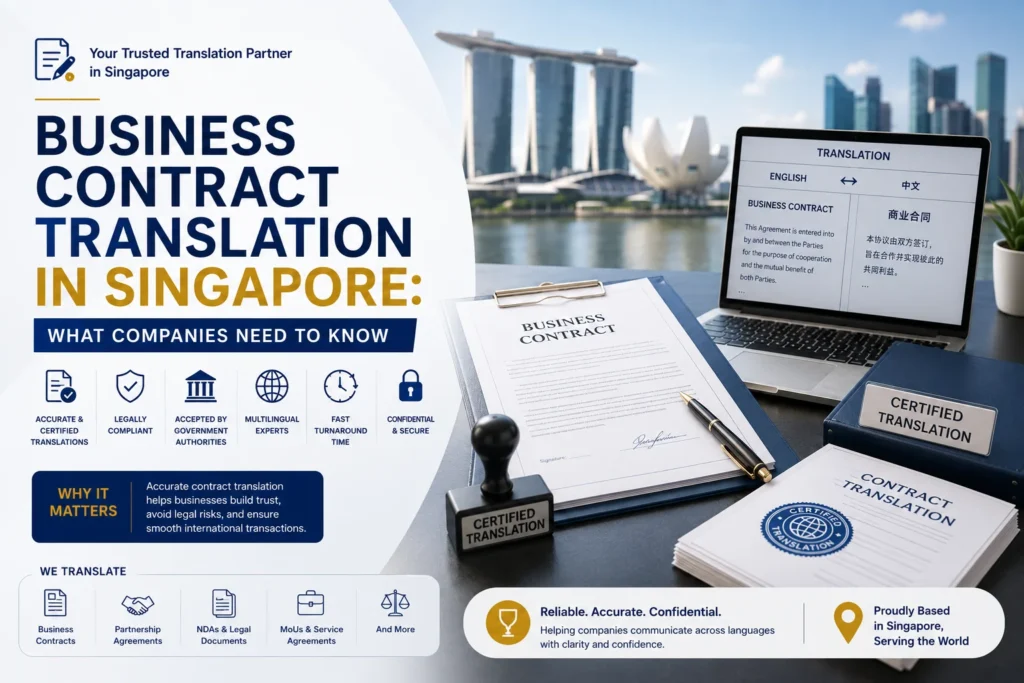
If a document will be submitted to a regulator, bank, court, or government agency, it will usually need to be a certified translation — not just a fluent one.
Certified vs. Standard Business Translation: Which Do You Need?
Not every business document requires certification. Internal communications, marketing materials, or informal correspondence can often be handled with standard professional translation. But contracts and agreements intended for legal, regulatory, or official use typically require certified translation, which comes with a signed statement of accuracy from the translator or agency — something authorities and courts can rely on.
If you’re unsure which applies to your situation, it’s worth asking your translation provider directly before submission, rather than risking a rejected filing later.
What to Look for in a Business Contract Translation Provider
Not all translators are equipped to handle contracts. When choosing a provider, look for:
- Subject-matter expertise — the translator should understand legal and commercial terminology, not just be bilingual
- Native-language translators working into their mother tongue, to ensure natural, precise phrasing
- Confidentiality safeguards — contracts often contain sensitive commercial terms, so NDAs and secure file transfer should be standard practice
- A second-editor review process to catch errors before delivery
- Experience with Singapore’s regulatory context, including ACRA, MAS, and court documentation standards where relevant
Common Mistakes Companies Make
- Using machine translation for signed agreements. Free tools can’t interpret legal nuance or context, and errors in a contract can be far more costly than in casual text.
- Skipping certification when it’s actually required, leading to delays or rejected submissions.
- Not accounting for cultural and legal context — some clauses that are standard in one jurisdiction may need adjustment or explanation in another.
- Leaving translation to the last minute, which increases the risk of rushed, lower-quality work on a document that carries real legal consequences.
Final Thoughts
For companies operating in or expanding into Singapore, business contract translation isn’t just about crossing a language barrier — it’s about protecting your commercial interests, ensuring compliance, and avoiding disputes down the line. Working with a translation partner who understands both the language and the legal context can make the difference between a contract that holds up and one that creates problems later.
Frequently Asked Questions
Does my business contract need certified translation in Singapore?
If the contract will be used for legal, regulatory, or official purposes — such as court proceedings, regulatory filings, or bank submissions — certified translation is typically required. Internal-use documents may not need certification.
Can I use machine translation for business contracts?
It’s not recommended. Machine translation cannot reliably interpret legal terminology, context, or the specific meaning of defined terms, which creates real risk in a binding document.
How long does business contract translation take?
Turnaround depends on document length and complexity, but most business and legal translations are completed within a few working days. Urgent requests can often be accommodated.
Are my contract details kept confidential?
A reputable provider will sign an NDA and use secure file transfer protocols to protect sensitive commercial information throughout the translation process.
Need certified business contract translation in Singapore? Contact Stanza Translations for a free quote — fast, accurate, and confidential.