When searching for a trusted translation provider, accuracy, speed, and official recognition matter. Whether you’re applying for permanent residency, a work pass, university admission, business registration, or legal proceedings, choosing the right translation company ensures your documents are accepted without unnecessary delays.
If you’ve been searching for Certified Translation Services Singapore, this comprehensive guide explains everything you need to know—from selecting a reliable provider to understanding which documents require certified translation and how to ensure your paperwork meets official requirements.
Why Certified Translation Matters
A certified translation is more than converting words from one language into another. It is an officially verified translation accompanied by a declaration confirming that the translated document accurately reflects the original.
Government agencies, educational institutions, embassies, courts, and employers often require certified translations to process applications safely and confidently.
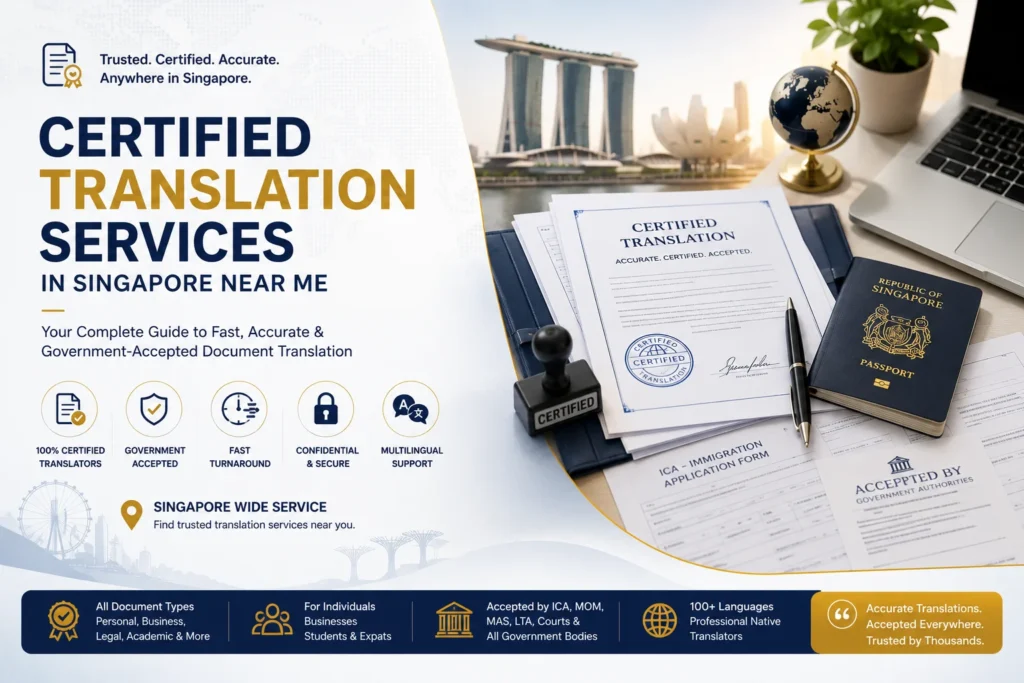
Unlike ordinary translations, certified translations are completed by qualified professionals and typically include:
- Certificate of Accuracy
- Translator’s signature
- Company seal or stamp
- Official declaration
- Complete formatting that mirrors the original document
These elements help establish authenticity for official use.
Why People Search “Certified Translation Services in Singapore Near Me”
Most people need urgent assistance when:
- Applying for Singapore PR
- Work Pass applications
- Student Pass applications
- Citizenship applications
- Employment overseas
- Visa processing
- University admissions
- Marriage registration
- Court submissions
- Immigration documentation
Finding a nearby professional translation provider saves valuable time while ensuring documents are prepared correctly.
Documents That Usually Need Certified Translation
Many official documents require certified translation before submission.
Personal Documents
- Birth Certificates
- Marriage Certificates
- Divorce Certificates
- Death Certificates
- Passports
- National Identity Cards
- Family Registers
Academic Documents
Educational institutions frequently request certified translations for:
- Degree Certificates
- Diplomas
- Academic Transcripts
- School Leaving Certificates
- Professional Certifications
- Mark Sheets
- Recommendation Letters
Immigration Documents
Immigration authorities often require translated copies of:
- Police Clearance Certificates
- Employment Letters
- Salary Certificates
- Tax Documents
- Bank Statements
- Residency Documents
Legal Documents
Legal paperwork demands exceptional accuracy, including:
- Court Orders
- Affidavits
- Power of Attorney
- Contracts
- Legal Agreements
- Wills
- Property Documents
Business Documents
Corporate organizations commonly translate:
- Company Registration Certificates
- Financial Statements
- Annual Reports
- Business Licenses
- Shareholder Agreements
- Articles of Incorporation
- Import and Export Documents
Languages Commonly Requested
Professional translation agencies in Singapore typically support more than 100–200 languages, including:
- English
- Chinese
- Malay
- Tamil
- Japanese
- Korean
- Arabic
- Hindi
- Bengali
- Thai
- Vietnamese
- Indonesian
- French
- German
- Spanish
- Russian
- Portuguese
- Italian
Many providers rely on native-language specialists for greater linguistic accuracy.
When Do You Need Certified Translation?
Certified translations are commonly required for:
Immigration
Authorities frequently request certified English translations for documents not originally issued in English.
Universities
International students often submit translated:
- Degree Certificates
- Academic Records
- Recommendation Letters
Employment
Global employers may ask for translated:
- Experience Letters
- Professional Certifications
- Educational Qualifications
Legal Proceedings
Courts require accurate legal translations that preserve every detail of the original document.
Business Expansion
International companies frequently translate:
- Contracts
- Financial Reports
- Product Manuals
- Marketing Materials
- Corporate Documentation
How Professional Certified Translation Works
A typical workflow includes:
Step 1: Submit Documents
Upload scans or clear photographs.
Step 2: Document Review
The translation team evaluates:
- Language pair
- Number of pages
- Complexity
- Delivery timeline
Step 3: Translation
Qualified translators prepare the document while preserving terminology, formatting, and meaning.
Step 4: Quality Assurance
Editors verify:
- Grammar
- Accuracy
- Formatting
- Consistency
- Completeness
Step 5: Certification
The final document receives the required certification statement, signature, and company stamp before delivery.
Features of a Reliable Translation Provider
Look for providers that offer:
Experienced Translators
Industry specialists with expertise in legal, medical, academic, and business documents.
Human Translation
Official documents should be translated by qualified professionals rather than relying solely on machine translation.
Quality Control
Multiple rounds of proofreading help minimize errors.
Confidentiality
Secure handling of personal and business documents protects sensitive information.
Fast Turnaround
Many agencies provide same-day or next-day services for standard documents, depending on complexity.
Common Industries That Need Certified Translation
Many sectors depend on certified translations, including:
- Healthcare
- Education
- Banking
- Insurance
- Manufacturing
- Government
- Construction
- Real Estate
- Information Technology
- Legal Services
- Human Resources
- Logistics
- Tourism
Benefits of Choosing a Professional Translation Agency
Professional agencies offer advantages such as:
- Accurate terminology
- Native-language expertise
- Official certification
- Confidential handling
- Faster processing
- Professional formatting
- Consistent quality
- Compliance with submission requirements
Common Mistakes to Avoid
Avoid these common errors:
Choosing the Cheapest Option
Poor-quality translations may result in rejected applications and additional costs.
Using Automatic Translation
Machine-generated translations often fail to meet official standards.
Ignoring Formatting
Incorrect formatting can create confusion during document verification.
Missing Certification
Without the required certification statement, some organizations may not accept the translation.
Waiting Until the Last Minute
Urgent requests may limit your delivery options.
Tips Before Submitting Your Documents
Before sending your documents:
- Check that scans are clear and readable.
- Include all pages.
- Verify names and dates.
- Confirm the required target language.
- Ask about turnaround times.
- Ensure certification is included.
- Keep digital copies for your records.
Choosing the Right Translation Company
A dependable provider should demonstrate:
- Extensive experience
- Qualified translators
- Transparent pricing
- Positive customer reviews
- Strong quality assurance
- Fast communication
- Confidential document handling
- Support for multiple languages
Frequently Asked Questions
What is a certified translation?
It is an officially verified translation accompanied by a signed declaration confirming its accuracy.
Can I translate my own documents?
For official submissions, self-translations are generally not accepted. Certified translations are typically expected from qualified professionals.
How long does a certified translation take?
Simple documents are often completed within one to two business days, while urgent services may be available depending on the provider.
Which documents usually require certified translation?
Birth certificates, marriage certificates, academic transcripts, legal agreements, immigration documents, financial records, and business documents are among the most common.
Are digital copies accepted?
Many organizations accept digitally delivered certified translations for initial submission, although some situations may require original hard copies.
Final Thoughts
Finding a reliable translation provider near you doesn’t have to be difficult. The right agency combines linguistic expertise, rigorous quality checks, secure document handling, and timely delivery to help you submit official paperwork with confidence. Whether your needs involve immigration, education, legal matters, business expansion, or personal documentation, investing in professional certified translation services can save time, reduce stress, and improve the likelihood of smooth document acceptance.