Singapore is one of the world’s most multilingual and internationally connected countries. With people and businesses interacting across borders every day, document translation has become an essential requirement for immigration, education, legal proceedings, healthcare, and corporate activities. Individuals moving to Singapore, students applying to institutions, companies expanding globally, and families handling official paperwork often need translated documents for submission and verification purposes.
Certified Translation Services Singapore services play a vital role in ensuring that official documents are accurately translated while maintaining the meaning, format, and legal integrity of the original content.
Whether it is a birth certificate for immigration, an academic transcript for university admissions, a legal agreement for court procedures, or medical records for treatment purposes, professional translation support helps avoid delays, misunderstandings, and compliance issues.
This guide explains document translation requirements in Singapore, common document categories, applications, industries served, and frequently asked questions to help individuals and organizations understand the process better.
What Is Document Translation?
Document translation refers to converting written content from one language into another while preserving meaning, structure, terminology, and context.
Unlike general language conversion, official document translation requires precision because translated content is often used for government submissions, institutional approvals, legal processes, and official verifications.
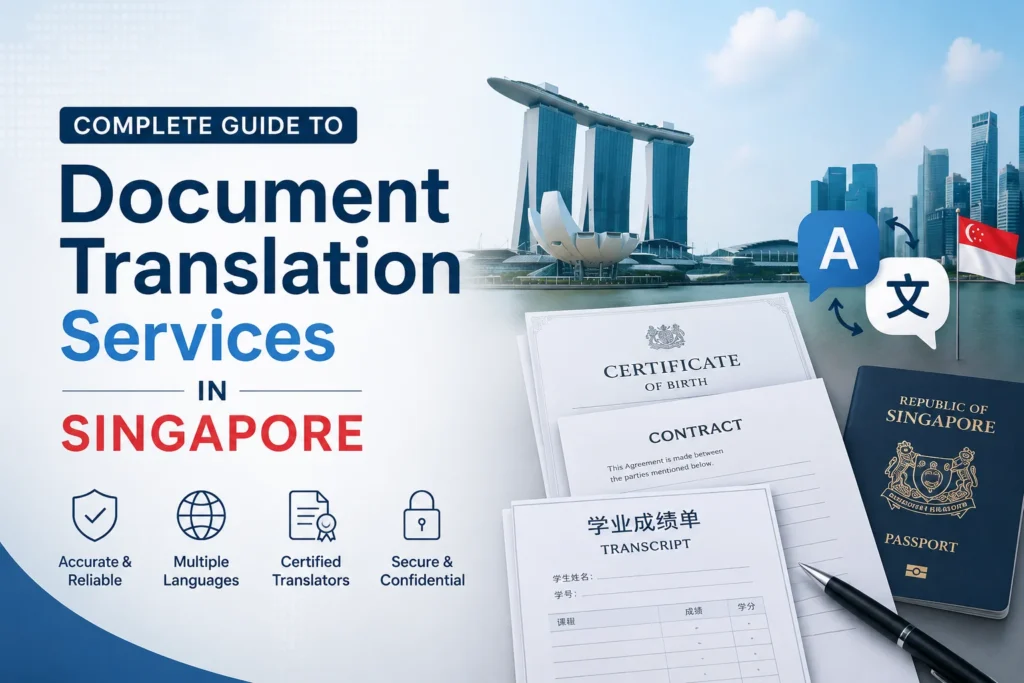
Documents requiring translation commonly include:
- Birth certificates
- Marriage certificates
- Academic transcripts
- Medical reports
- Immigration papers
- Employment documents
- Business contracts
- Government certificates
- Financial statements
- Court documents
Professional translation ensures that the translated document accurately reflects the original without omissions or interpretation errors.
Why Document Translation Is Important in Singapore
Singapore functions as an international hub for education, finance, trade, healthcare, and immigration. People from different countries regularly submit documents in multiple languages.
Translation becomes important because authorities and institutions may require records in accepted languages for verification and processing.
Common situations include:
Immigration Procedures
Applicants submitting foreign-language documents often need translated versions for review.
Examples include:
- Birth records
- Marriage documents
- Identity papers
- Family records
Education Applications
Students pursuing studies locally or internationally may require translated academic documents.
These may include:
- Degree certificates
- Diplomas
- Mark sheets
- Recommendation letters
Legal Purposes
Legal systems rely on accurate language interpretation.
Translation may be required for:
- Contracts
- Court documents
- Agreements
- Affidavits
Healthcare Services
Medical translation helps doctors, patients, and institutions understand records correctly.
Documents often translated:
- Diagnostic reports
- Medical histories
- Insurance files
- Prescriptions
Types of Document Translation Services in Singapore
Different industries require specialized translation approaches because terminology varies significantly.
1. Legal Translation Services
Legal documents contain technical terminology where accuracy is essential.
Common legal documents include:
- Contracts
- Court orders
- Affidavits
- Arbitration records
- Power of attorney papers
- Company legal documents
Legal translation requires understanding legal terminology and maintaining contextual accuracy.
Typical users include:
- Law firms
- Corporate organizations
- Individuals
- Courts
- International businesses
2. Academic Translation Services
Education-related translation supports students, professionals, and institutions.
Common academic documents:
- Academic transcripts
- Degree certificates
- Diplomas
- School records
- Research papers
- Recommendation letters
Academic translation is frequently used for:
- Overseas admissions
- Scholarship applications
- Employment verification
- Professional licensing
Educational institutions often require clear and consistent translations for evaluation.
3. Medical Translation Services
Healthcare information demands exceptional precision.
Medical document translation may include:
- Clinical reports
- Laboratory results
- Hospital records
- Insurance papers
- Vaccination records
- Medical certificates
Errors in healthcare translation may affect treatment decisions and administrative procedures.
Healthcare translation supports:
- Hospitals
- Clinics
- Patients
- Insurance providers
- Medical tourism services
4. Business Translation Services
Global companies require multilingual communication to support expansion.
Business documents often translated include:
- Company profiles
- Marketing materials
- Financial reports
- Product manuals
- Corporate presentations
- Employee documents
Business translation helps organizations communicate effectively with international stakeholders.
5. Government and Administrative Translation
Government procedures frequently involve document verification.
Examples include:
- Identity documents
- Residency paperwork
- Family records
- Administrative certificates
- Visa papers
- Registration documents
Accurate translation helps simplify processing procedures.
Common Documents That Need Translation
Personal Documents
Individuals commonly translate:
- Birth certificates
- Marriage certificates
- Divorce certificates
- Identity cards
- Passports
- Family records
Educational Documents
Students often require translation for:
- Diplomas
- Degrees
- Transcripts
- Academic evaluations
Employment Documents
Professionals may translate:
- Employment certificates
- Experience letters
- Salary records
- Professional licenses
Legal Documents
Legal paperwork includes:
- Agreements
- Court judgments
- Legal notices
- Declarations
Healthcare Records
Medical paperwork includes:
- Reports
- Certificates
- Prescriptions
- Treatment histories
How the Document Translation Process Works
The translation process generally follows several stages to maintain quality and consistency.
Step 1: Document Review
The document is reviewed to understand:
- Language pair
- Complexity
- Technical terms
- Formatting needs
Step 2: Translation
Professional translators convert content while preserving meaning.
Focus areas include:
- Accuracy
- Terminology
- Structure
- Context
Step 3: Editing and Verification
The translated document undergoes quality checks.
Review includes:
- Grammar verification
- Technical accuracy
- Formatting checks
- Terminology consistency
Step 4: Final Delivery
The final version is prepared for submission or usage.
Industries That Frequently Use Translation Services
Immigration Sector
Immigration procedures often involve multilingual documentation.
Documents include:
- Civil certificates
- Identification papers
- Family records
Education Sector
Schools and universities frequently process translated records.
Common users:
- Students
- Educational institutions
- Scholarship organizations
Healthcare Sector
Hospitals and clinics require translated medical information for treatment coordination.
Corporate Sector
Businesses use translation for:
- International communication
- Documentation
- Marketing expansion
Legal Sector
Law firms and courts rely on precise legal translations.
Languages Frequently Requested in Singapore
Singapore’s multicultural environment increases demand for multilingual translation.
Common language combinations include:
- English
- Chinese
- Malay
- Tamil
- Arabic
- Japanese
- Korean
- Indonesian
- Thai
- Vietnamese
- French
- German
- Spanish
Multilingual support helps individuals and organizations operate internationally.
Factors to Consider When Choosing a Translation Provider
Selecting the right translation service affects document acceptance and processing efficiency.
Important considerations include:
Experience
Look for providers experienced in official documentation.
Language Expertise
Industry-specific language knowledge improves quality.
Confidentiality
Sensitive information requires secure handling.
Accuracy
Precision helps avoid rejections and delays.
Industry Specialization
Different sectors require different expertise.
Examples:
- Legal terminology
- Medical terminology
- Academic language
- Corporate language
Benefits of Professional Document Translation
Improved Accuracy
Professional translators understand terminology and context.
Better Communication
Translation removes language barriers.
International Accessibility
Documents become usable across borders.
Reduced Errors
Proper review minimizes inconsistencies.
Faster Processing
Accurate submissions reduce administrative delays.
Conclusion
Document translation has become an essential service in Singapore due to international mobility, global business operations, multilingual communities, and administrative requirements.
From educational records and legal paperwork to medical reports and business files, accurate translation helps individuals and organizations communicate effectively while meeting official requirements.
Professional document translation improves clarity, preserves original meaning, reduces errors, and supports smooth processing across various sectors.
As global interactions continue to grow, reliable translation remains an important bridge connecting people, institutions, and opportunities across languages and borders.
Frequently Asked Questions
What documents usually require translation in Singapore?
Common documents include birth certificates, marriage records, educational certificates, legal papers, medical reports, and employment documents.
Why is professional document translation important?
Professional translation ensures accuracy, preserves meaning, and supports official submissions.
Are educational documents commonly translated?
Yes. Degrees, diplomas, transcripts, and recommendation letters are frequently translated for admissions and employment purposes.
Which industries use document translation most?
Immigration, healthcare, education, legal services, and corporate organizations commonly require translation support.
What languages are most requested?
English, Chinese, Malay, Tamil, Arabic, Japanese, Korean, and several international languages are frequently requested.