Introduction
Singapore is globally recognized for its efficient public housing system, with the Housing & Development Board (HDB) playing a significant role in providing quality housing for residents. Every year, thousands of Singaporeans, Permanent Residents, and eligible individuals apply for HDB flats, transfers, ownership changes, inheritance matters, resale transactions, and various housing-related services.
Many applicants have personal, educational, legal, or family documents issued outside Singapore. When these documents are written in a foreign language, they often need professional translation before they can be properly reviewed during administrative processes.
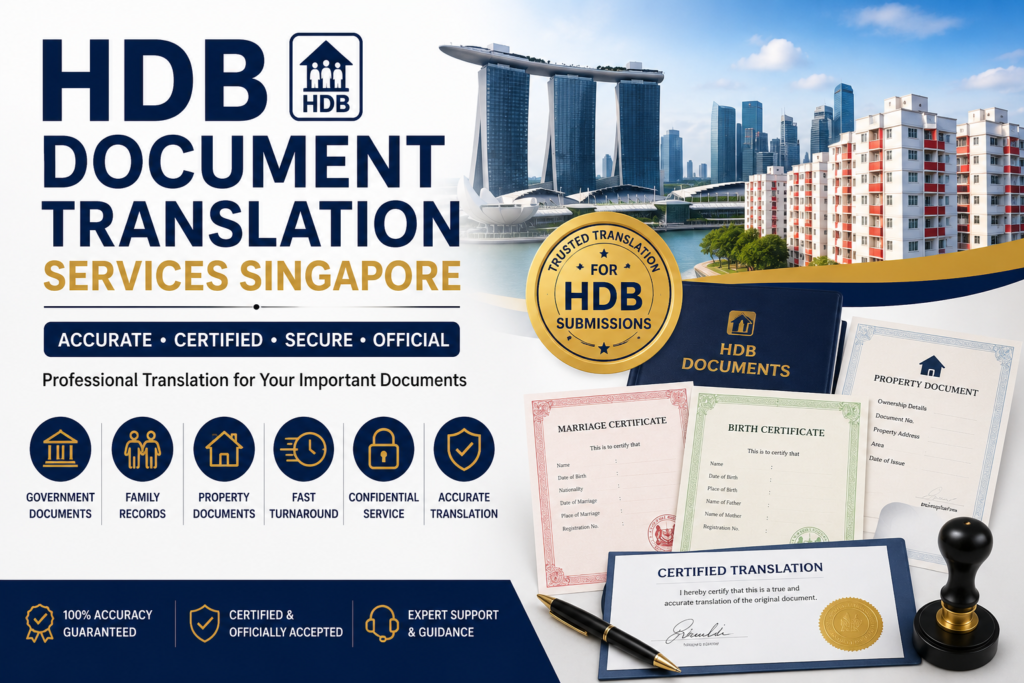
Legal Translation Singapore services support individuals by translating official housing-related documents accurately while preserving their original meaning, terminology, and formatting.
This guide explains everything you need to know about HDB document translation, including the types of documents commonly translated, situations where translation is required, benefits, translation workflow, best practices, and frequently asked questions.
Understanding HDB Documentation
The Housing & Development Board manages numerous housing-related administrative procedures involving document verification.
Applicants may need to provide supporting documents for various reasons, including:
- Flat purchases
- Resale transactions
- Family ownership matters
- Marriage-related applications
- Housing eligibility assessments
- Ownership transfers
- Estate administration
- Administrative updates
When documents originate from another country or language, accurate translation helps authorities review the information efficiently.
Why HDB Document Translation Is Important
Official housing procedures rely heavily on document verification.
Professional translation helps ensure that every piece of information is clearly understood.
Improves Administrative Accuracy
Housing applications require precise personal and family information.
Accurate translations help reduce misunderstandings.
Supports Identity Verification
Many applications involve identity verification using multiple official documents.
Translation helps maintain consistency across records.
Facilitates International Documentation
Individuals relocating from overseas often submit foreign-issued documents.
Translation removes language barriers during evaluation.
Reduces Processing Delays
Clear documentation minimizes requests for clarification and additional submissions.
Maintains Document Integrity
Professional translation preserves the original meaning of every document without altering its content.
Common Documents That May Require Translation
Several types of documents are commonly associated with housing-related applications.
Birth Certificates
Birth certificates help verify identity and family relationships.
Information commonly includes:
- Full name
- Date of birth
- Parent information
- Registration details
Marriage Certificates
Marriage documents may support family-related housing applications.
Typical information includes:
- Spouse names
- Marriage registration date
- Registration authority
Divorce Certificates
Where applicable, divorce documentation may be submitted to support ownership or family status.
Identity Documents
Common identity records include:
- Passports
- National identity cards
- Residence documents
Family Registration Records
Some countries issue official family registration documents.
These may include:
- Family members
- Parent-child relationships
- Household registration
Death Certificates
Estate and inheritance matters may require translated death certificates.
Court Orders
Housing ownership changes may involve court-issued documents.
Examples include:
- Family court orders
- Probate documentation
- Guardianship orders
Affidavits
Certain administrative procedures may involve sworn declarations.
Property-Related Documents
Housing matters sometimes require supporting documentation such as:
- Property ownership records
- Foreign property certificates
- Administrative approvals
Situations That May Require Document Translation
Translation becomes necessary in many housing-related situations.
Flat Purchase Applications
Applicants may provide supporting personal documentation during eligibility assessments.
HDB Resale Transactions
Resale procedures often involve verification of identity and supporting records.
Family Nucleus Verification
Certain applications require proof of family relationships.
Supporting documents may include:
- Birth certificates
- Marriage certificates
- Family registration documents
Ownership Transfer
Ownership transfers may require legal and administrative documentation.
Estate Administration
Property inheritance procedures often involve:
- Death certificates
- Probate documentation
- Family records
Change of Personal Particulars
Administrative updates may require supporting translated documents.
Categories of Documents Commonly Translated
Personal Documents
Examples include:
- Birth certificates
- Marriage certificates
- Identity documents
Family Documents
Examples:
- Household registrations
- Family certificates
- Civil records
Legal Documents
These include:
- Court orders
- Affidavits
- Probate papers
- Administrative judgments
Government-Issued Documents
Examples include:
- Civil registration records
- National identification documents
- Residency certificates
The Translation Process
Professional document translation follows a structured quality workflow.
Step 1: Document Review
Each document is carefully examined.
The review includes:
- Source language
- Document type
- Formatting
- Completeness
Step 2: Terminology Assessment
Official administrative terminology is identified before translation begins.
Examples include:
- Government departments
- Registration authorities
- Official references
Step 3: Translation
The document is translated while preserving:
- Names
- Dates
- Official terminology
- Formatting
- Context
Step 4: Editing
Professional reviewers check:
- Grammar
- Accuracy
- Completeness
- Consistency
Step 5: Quality Verification
Final verification ensures the translated document reflects the original accurately.
Common Challenges in HDB Document Translation
Although many official documents appear simple, translation requires careful attention.
Multiple Languages
Applicants submit documents from many countries.
Each language requires specialized knowledge.
Different Administrative Systems
Government terminology differs significantly between countries.
Proper interpretation helps preserve meaning.
Name Variations
Names may appear differently across documents.
Maintaining consistency is essential.
Date Formats
Countries use different date formats.
Examples include:
- DD/MM/YYYY
- MM/DD/YYYY
- YYYY/MM/DD
Incorrect interpretation may create inconsistencies.
Older Documents
Historical records sometimes contain handwritten entries or outdated administrative terminology.
These require additional review.
Languages Frequently Requested
Singapore receives documentation in many languages.
Common language pairs include:
- English
- Chinese
- Malay
- Tamil
- Arabic
- Japanese
- Korean
- Indonesian
- Thai
- Vietnamese
- French
- German
- Spanish
These languages support Singapore’s diverse international community.
Benefits of Professional HDB Document Translation
Professional translation offers several important advantages.
Accurate Information
Every detail is carefully translated.
Consistent Documentation
Names, dates, and locations remain aligned across all supporting records.
Better Readability
Authorities can review documents more efficiently.
Reduced Administrative Delays
Properly translated documents reduce requests for additional clarification.
Improved International Communication
Translation helps bridge language differences between applicants and government authorities.
Best Practices Before Submitting HDB Documents
Preparing your documents properly before translation can help avoid unnecessary delays and improve the overall review process. Following a few best practices ensures your documents are complete, readable, and consistent.
Organize All Supporting Documents
Before requesting a translation, gather all related documents in one place. This may include:
- Birth certificates
- Marriage certificates
- Identity documents
- Court documents
- Family registration records
- Property-related documents
Having everything prepared helps maintain consistency across translations.
Verify Personal Information
Check that the following details are identical across all documents:
- Full name
- Date of birth
- Passport number
- Identification number
- Parent names
- Address information
Any differences should be clarified before submission.
Submit Clear Copies
Blurry or incomplete copies may create unnecessary delays.
Ensure documents are:
- Clearly scanned
- Complete
- Easy to read
- Properly aligned
- Free from missing pages
Preserve Original Documents
Always keep original copies in a safe place.
Authorities may request the originals during verification.
Start Early
Housing applications often have submission timelines.
Preparing translations well in advance reduces unnecessary stress.
Industries That Frequently Require HDB-Related Document Translation
Professional document translation supports multiple industries beyond housing.
Government Sector
Government agencies regularly process official documentation involving:
- Identity verification
- Family relationships
- Civil registration
- Administrative approvals
Legal Sector
Legal professionals frequently require translated documents involving:
- Probate matters
- Family law
- Court proceedings
- Estate administration
Real Estate Industry
Property professionals may require translated supporting documentation during ownership-related procedures.
Immigration Services
Housing applications often overlap with immigration documentation.
Supporting records may include:
- Identity documents
- Family records
- Residency documentation
Financial Institutions
Banks sometimes request translated supporting documents during financing or property-related assessments.
Advantages of Professional HDB Document Translation
Professional translation offers several long-term benefits.
Accurate Communication
Every important detail is translated carefully without changing the original meaning.
Consistency Across Documents
Professional translators maintain consistent spelling for:
- Names
- Places
- Government departments
- Administrative references
Improved Administrative Efficiency
Well-prepared documents reduce requests for corrections or additional clarification.
Better International Accessibility
Foreign-issued documents become easier for Singapore authorities to understand.
Professional Presentation
Proper formatting improves readability and demonstrates attention to detail.
Common Mistakes to Avoid
Many applicants unintentionally create delays by making avoidable mistakes.
Submitting Poor-Quality Copies
Low-resolution scans make translation difficult.
Using Different Spellings
Names should remain consistent across:
- Passports
- Birth certificates
- Marriage certificates
- Identity documents
Missing Supporting Documents
Incomplete submissions may require additional follow-up.
Waiting Until the Last Minute
Early preparation allows time for corrections if necessary.
Ignoring Formatting
Official documents often contain:
- Tables
- Registration numbers
- Government seals
- Official references
Maintaining these elements improves clarity
Conclusion
HDB-related applications often involve important personal, family, legal, and administrative documents that originate from different countries and languages. Clear, accurate translation helps ensure these records are understandable, consistent, and professionally presented for official review.
From birth certificates and marriage certificates to identity documents, court orders, probate records, and family registrations, every document contributes to a complete and accurate application. Proper translation minimizes misunderstandings, supports administrative efficiency, and improves communication between applicants and authorities.
As Singapore continues to serve a diverse and international population, professional document translation remains an essential part of housing-related administrative processes. Preparing documents carefully, maintaining consistency across records, and ensuring accurate translations can contribute to smoother applications and more efficient document verification.