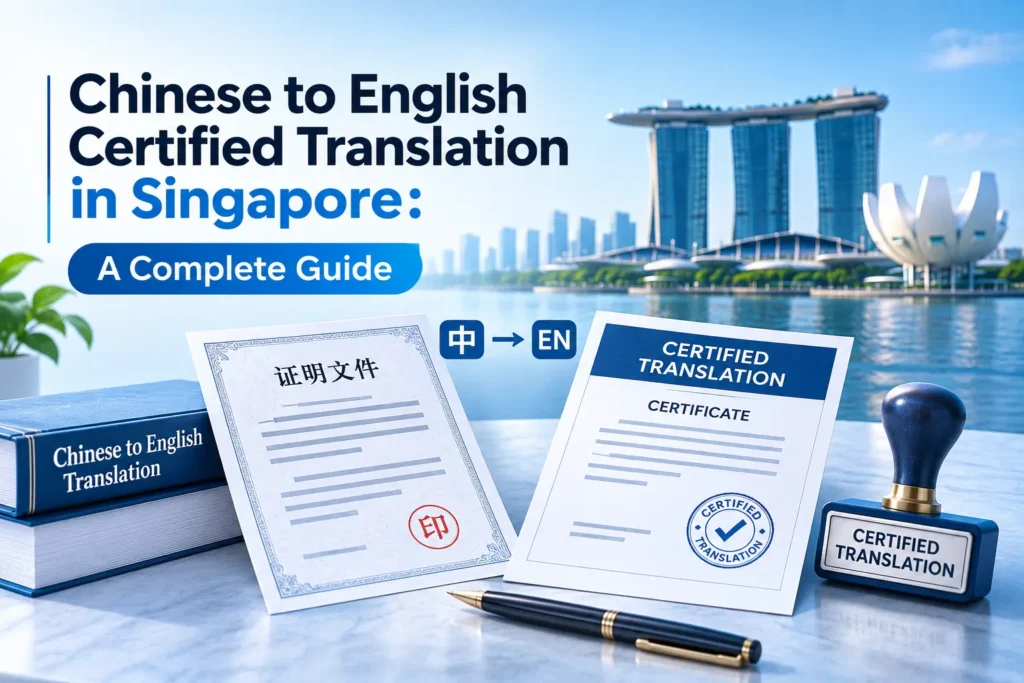
Chinese is one of the most common source languages for official document translation in Singapore. Every year, thousands of residents, students, employees, and families submit documents issued in China, Taiwan, Hong Kong, or Chinese speaking communities elsewhere to Singapore government agencies. Because most of these agencies work in English, a certified English translation is usually required before the application can proceed.
This guide explains what Chinese to English certified translation involves, which documents commonly need it, the details that trip people up, and how to get it done smoothly.
What Is a Chinese to English Certified Translation?
A certified translation is a complete and accurate English rendering of your Chinese document, accompanied by a signed statement from the translator or translation agency confirming accuracy. It normally includes the agency’s stamp, contact details, and a clear reference to the original document.
This differs from an ordinary translation, which may be perfectly readable but carries no accountability. Authorities such as ICA, MOM, HDB, and the courts want to know that a qualified, traceable professional stands behind the translation. If you are new to the concept, our guide on what certified translation is in Singapore and who needs it is a good starting point, and you can see our full offering on the certified translation service page.
Documents That Commonly Need Chinese to English Translation
Immigration and Residency Documents
Applicants for permanent residency, citizenship, long term passes, or dependant passes often submit Chinese birth certificates, marriage certificates, divorce papers, household registration records, and police clearance certificates. These are typically handled under ICA requirements. Read our overview of ICA document translation requirements in Singapore and our service page for ICA submissions.
Education and Employment Documents
Degree certificates, diplomas, transcripts, and employment records issued in China frequently need translation for work pass applications. See our article on education certificate translation for MOM and the MOM translation page for what is expected. Students and professionals may also find our diploma certificate translation guide helpful.
Family and Civil Documents
Couples registering a marriage in Singapore, or families dealing with housing and legal matters, often need translated civil records. Our pages on the Registry of Marriages (ROM) and birth certificate translation cover these cases in more detail.
Housing, Legal, and Medical Documents
HDB applications can involve Chinese language income records, employment letters, and family documents. Courts and law firms may need translated contracts, affidavits, and court orders, and medical providers or insurers may require translated diagnosis reports. Explore our services for HDB submissions, legal translation, and medical translation.
Chinese Translation Challenges That Require Real Expertise
Chinese to English translation is not simply a matter of swapping words. Several features of the language and its documents demand careful handling.
Simplified vs Traditional Characters
Mainland China uses Simplified Chinese, while Taiwan and Hong Kong commonly use Traditional Chinese. A competent translator should be comfortable with both, since some documents even mix them. Misreading a character can alter a name or a place.
Name Romanisation
Chinese names can be written in English using Hanyu Pinyin, older systems, or dialect based spellings such as Hokkien, Cantonese, or Teochew. A person’s name in a Singapore record may not match the pinyin version on a Chinese certificate. The translator should follow the spelling shown in your passport or other official records wherever possible, so identity checks do not fail on a technicality. Always tell your translation provider how your name appears in your passport.
Name Order
Chinese names place the family name first, while English convention places it last. Your translation should align with the order used in your official Singapore documents, and this should be applied consistently across every document in your application.
Official Seals, Stamps, and Annotations
Chinese certificates often carry red seals (chops), handwritten notes, and registry stamps. These are part of the document’s authenticity, so they must be translated or at least described. Leaving them out is a common reason for rejection.
Terminology and Formal Language
Legal, academic, and governmental Chinese uses formal terms with no single obvious English equivalent. Titles of institutions, degree names, and administrative regions should be rendered accurately and consistently. A specialist translator will know the accepted English equivalents and will keep them uniform across your documents.
Dates, Numbers, and Place Names
Dates written in Chinese formats need to be converted carefully, and addresses and place names should follow standard romanisation. Even a small slip in a birth date or address can create inconsistencies with other records.
Certified, Notarised, or Authenticated: Which Do You Need?
For many Singapore submissions, certified translation alone is enough. In some situations, however, the receiving party also wants the translation notarised or authenticated. This is common for cross border legal or business use. Our comparison of certified vs notarised translation in Singapore explains when each step applies, so you can plan the whole process in one go instead of repeating work.
Why Chinese Document Translations Get Rejected
Most rejections come from avoidable issues:
- Translations done by friends, relatives, or free software
- Missing translation of stamps, seals, or handwritten remarks
- Name spellings that do not match the passport
- Incomplete translation of multi page documents
- Missing certification statement or agency details
Our article on why certified translation gets rejected by authorities lists these pitfalls in more detail and shows how to avoid them.
How the Process Works
- Share clear copies. Send scans or sharp photographs showing every page, seal, and note.
- Confirm details. Tell your provider the purpose, the receiving authority, and how your name appears in your passport.
- Receive a quote and timeline. Reputable agencies provide this before starting.
- Translation by a qualified linguist. Ideally, a native English speaker or an expert translator with strong Chinese reading skills handles the work.
- Review and quality check. A second reviewer verifies accuracy, spelling, and formatting.
- Certification and delivery. You receive the signed, stamped translation ready for submission.
Most certified translations are completed within one to three working days, depending on length and complexity. Our guide on how long certified translation takes in Singapore offers a fuller breakdown, and urgent requests may be accommodated if you flag them early.
Tips for a Smooth Experience
Start early. Collect your Chinese documents as soon as you know you need them, since replacing a lost or outdated certificate from overseas can take time.
Keep names consistent. Use one spelling across every submission.
Provide the full document. Include back pages, attachments, and any stamped sections.
Ask about format. Some authorities prefer translations that mirror the original layout. See our guide to the official translation format accepted by authorities.
Check which languages need translation. Our article on which languages must be translated into English in Singapore can help you confirm your situation.
Frequently Asked Questions
Can I translate my Chinese documents myself?
No. Authorities generally require an independent professional translator so that accuracy and impartiality can be assured.
Do you handle both Simplified and Traditional Chinese?
A qualified provider should handle both, along with documents from mainland China, Taiwan, Hong Kong, and Singapore.
Will a translation done in China be accepted in Singapore?
Not always. Many Singapore agencies prefer translations from a recognised Singapore based provider, so it is worth confirming before you submit.
Can scanned or photographed documents be translated?
Yes, as long as every detail is clear and legible.
Get Your Chinese Documents Translated With Confidence
A precise, properly certified translation protects your application from delays and rejections. Stanza works with experienced native speaker translators, provides fast turnaround, and keeps every document confidential. Browse all our translation services, see our English translation service, or contact our team for a free quote today.