Applying for a visa, permanent residency, or an embassy service is rarely quick. Between forms, appointments, and supporting paperwork, the last thing you want is a rejection because a document was in the wrong language or translated by the wrong person.
Whether you are moving to Singapore, leaving Singapore for another country, or dealing with an embassy based here, authorities almost always expect documents to be in English or in the official language of the receiving country. If your paperwork is in any other language, you will need a certified translation. This checklist walks you through the documents most commonly required, how to prepare them, and how to avoid the mistakes that cause delays.
Why Visa and Embassy Applications Require Certified Translation
Immigration officers and embassy staff cannot verify the accuracy of a document they cannot read. A certified translation solves this by including a signed statement from the translator or translation agency confirming that the translation is complete and accurate. It usually carries the agency’s stamp, contact details, and a reference to the original document.
A casual translation by a friend, relative, or free online tool will typically be rejected. Authorities want an independent, accountable source, so that any question about the content can be traced back to a professional provider. If you would like a refresher on what makes a translation acceptable, our guide on what makes a translation certified under Singapore regulations explains it clearly.
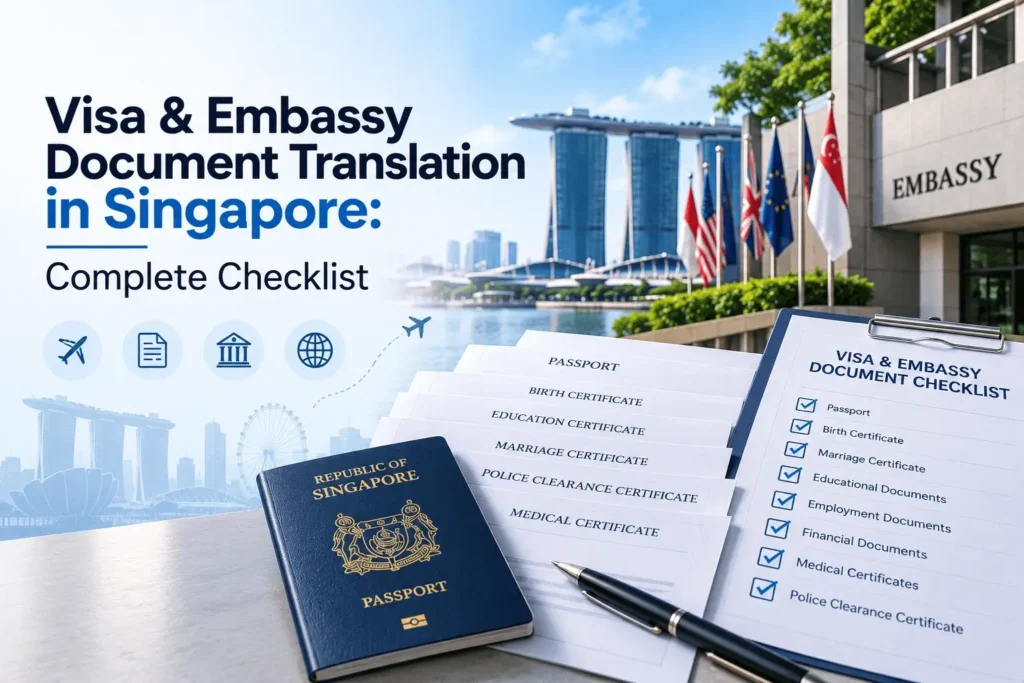
The Complete Document Checklist
Requirements vary by country and visa type, so always confirm with the relevant authority. That said, the following documents come up again and again.
Personal Identity Documents
- Birth certificate. Required for almost every visa, PR, citizenship, or dependant application. See our birth certificate translation guide for details.
- Passport biodata page. Needed only when the passport is not in English or uses a non Latin script.
- National identity card. Often requested to confirm name spelling and date of birth.
- Name change documents. Deed poll papers or legal name change certificates, so authorities can match your identity across records.
Family and Relationship Documents
- Marriage certificate. Essential for spouse and dependant visas. Read more in our article on marriage certificate translation for ICA.
- Divorce certificate or decree. Required to show a previous marriage has legally ended.
- Death certificate. Needed in cases involving a deceased spouse or parent.
- Adoption papers or custody orders. Often required when applying for children’s visas.
- Family registration documents. Used in several Asian countries as proof of family relationships.
Education and Employment Documents
- Degree certificates and diplomas. Frequently requested for work passes and skilled migration. Our guide on diploma certificate translation in Singapore covers what to expect.
- Academic transcripts. Often needed alongside certificates to verify courses and grades.
- Employment letters and testimonials. Used to confirm work history, salary, and job titles.
- Curriculum vitae. Sometimes required in the official language of the receiving authority.
- Professional licences. Needed when your occupation is regulated.
Financial Documents
- Bank statements. Used to prove financial stability for long term visas or study permits.
- Payslips and income statements. Support work pass and dependant applications.
- Tax records. Requested for investor or entrepreneur visas.
- Sponsorship letters. Needed when someone else is supporting your application financially.
Medical and Background Documents
- Medical certificates and health reports. Commonly required for long stay visas. Our post on medical certificate translation for visa applications covers this in depth.
- Vaccination records. Often requested for study, work, or family visas.
- Police clearance certificates. Required by many countries as proof of good conduct.
Legal and Supporting Documents
- Affidavits and statutory declarations. Used when standard documents are unavailable.
- Powers of attorney. Needed when someone applies on your behalf.
- Court orders. Relevant in custody, name change, or legal status matters.
- Citizenship renunciation documents. Required in certain naturalisation cases.
Special Considerations for Singapore Applications
If you are applying to ICA for permanent residency, citizenship, or long term passes, the rules around translation are strict. Our guide on ICA document translation requirements in Singapore covers formatting, certification, and common pitfalls, and our ICA translation service page outlines what we support. For work pass applicants, the article on employment pass document translation in Singapore is a useful companion read.
Do You Also Need Notarization or Authentication?
Some embassies and foreign authorities require more than a certified translation. They may ask for the translation to be notarised or authenticated so it is recognised abroad. This is common for documents going to countries with stricter legal formalities. The requirements differ widely, so confirm with the receiving embassy first. Our comparison of certified vs notarised translation in Singapore explains when each is needed, so you can avoid doing the process twice.
Step by Step: How to Prepare Your Documents
- Confirm requirements first. Check the official website or contact the embassy or immigration authority to see which documents need translation and in what language.
- Gather clear copies. Scan or photograph every page, including stamps, seals, and handwritten notes. Cropped or blurry images slow down the process.
- Identify the target language. Some embassies want English, while others want their own official language.
- Request a quote. A reliable provider will review your documents and give a quote and timeline before work begins.
- Review the draft. Check that names, dates, and numbers match your passport and other records exactly.
- Arrange notarization if needed. Ask about this early so everything is completed together.
- Submit well before the deadline. Build in extra time for corrections or resubmission.
Common Mistakes That Lead to Rejection
Inconsistent name spelling. If your name appears differently across documents, authorities may question your identity. Always ensure spellings match your passport.
Translating only part of a document. Stamps, seals, margin notes, and handwritten remarks must also be translated. Partial translations are a common reason for rejection.
Using an uncertified source. Translations by friends, family, or free software are rarely accepted.
Leaving it too late. Rushing leads to errors. Start translation as soon as you begin collecting your documents.
Ignoring format rules. Some authorities expect the translation to mirror the original layout. Our post on the official translation format accepted by authorities explains how this works.
How Long Does Translation Take?
Most certified translations are completed within one to three working days, depending on length, language, and complexity. Urgent and same day requests may be possible with advance notice. For a more detailed breakdown, read our article on how long certified translation takes in Singapore.
Frequently Asked Questions
Can I translate my own documents for a visa application?
No. Authorities generally require an independent, certified translator to ensure accuracy and impartiality.
Do I need to translate documents that are already in English?
Usually not. Only documents in other languages need translation, although some embassies want translation into their own language.
What if my document is handwritten or scanned?
Clear scans and photographs are usually acceptable, as long as every detail is legible.
Will my translation be accepted by every embassy?
Acceptance depends on each embassy’s rules. A certified translation meets the standard in most cases, but always confirm whether extra steps are needed.
Get Your Visa and Embassy Documents Translated With Confidence
A well prepared application saves time, money, and stress. Stanza offers certified translations accepted by ICA, MOM, embassies, and other official bodies, with fast turnaround, native speaker translators, and strict confidentiality. Explore our visa and immigration translation services, learn more about our certified translation service, or contact us today for a free quote.